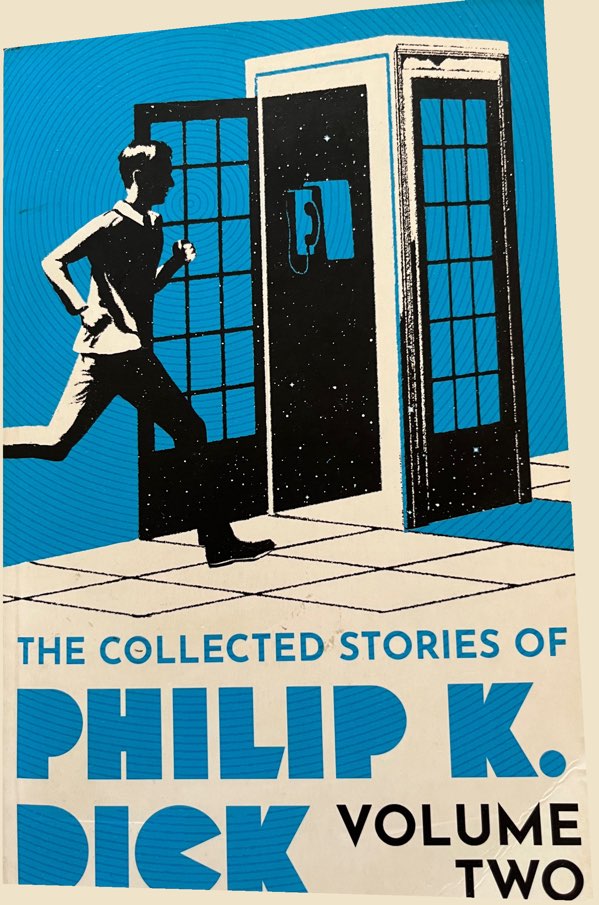
I don’t have the first volume in this series, and this second volume I’d picked up a couple of years ago (along with a bunch of more contemporary short story anthologies from a store brimming with books to the ceiling, arranged to maximize entropy), only right now got around to reading it.
He’s great. Not news to me, but still I get the thrill of rediscovering that one you vaguely remember as being great turns out to be so in your exposure to even their less known work.
All the stories in this book are new to me. All are good. All are unique.
Before reading this, I’d read the other book I’d picked alongside it, the smaller and more contemporary, some booker or whatever prize winning collection of writings from some Korean author. Everything was good. The writing was top notch. The stories had a twist. They had the right mix of despondency and utopia.
But there was no juice. It was all pulp.
At that time, I put it on myself, that I’d read too much fiction, so my bar is unhinged, and my piqued thresholds too high.
But then I start reading old friend PKD, and wow.
I’ve thought about why it happened. I think the reason is that the contemporary one is committing the one and the most common sin that makes good craft not be good art — have an agenda. Art with an agenda is propaganda. The contemporary one (I’ve forgotten the name of the author and book; I can get it from the almirah but there’s no point — I don’t want to badmouth them by name, it’s not that I disliked them, I had an okay time reading them, I only talk less of them as a contrasting device) had everything — the author was even an MFA, had support for all the right causes, had even an epilogue where she talked of her real world activism.
But her universes seem to be grasping towards something lost. As if in the author’s mind there was an imagined but reified universe, and the stories were about what went wrong when things were not what they should be.
In Philip’s universes, there is no ideal. The stories just are.
The closest I see to an agenda for Philip (a premise really, but it is a strong one) is the certainty that humans are chauvinistic about their consciousness.
The writing, in classic PKD fashion, is nothing spectacular (though I found the writing better than what I remember from his novels). The stories generally didn’t have a twist. Some did, but most (and the ones I liked more) just were. They were not reaching to some destination, nor were they trying to convey a message, nor were they written by an author with an agenda. Most of them just didn’t go anywhere — they were more like vignettes than actual stories. It even feels (I’ve still not read the whole book) as if these were his sketches of scenes that’ll hang together on a clothesline some day for some novel he’d write but never did.
They have potential. They spark in me curiosity, and energy, and a feeling to bring in a future that has not been even imagined yet.
Growth vs grace, is how I’d framed these two perspectives years ago. Growth doesn’t take the universe as fixed. Grace takes the universe as fixed and tries to make it a good home by making sure the porch has flowers.
As with everything, you need a mixture of both, but I do feel society in general and fiction in particular (the small snippets I’ve read recently; my peephole just might be too small) are just too much grace and not enough imagination.